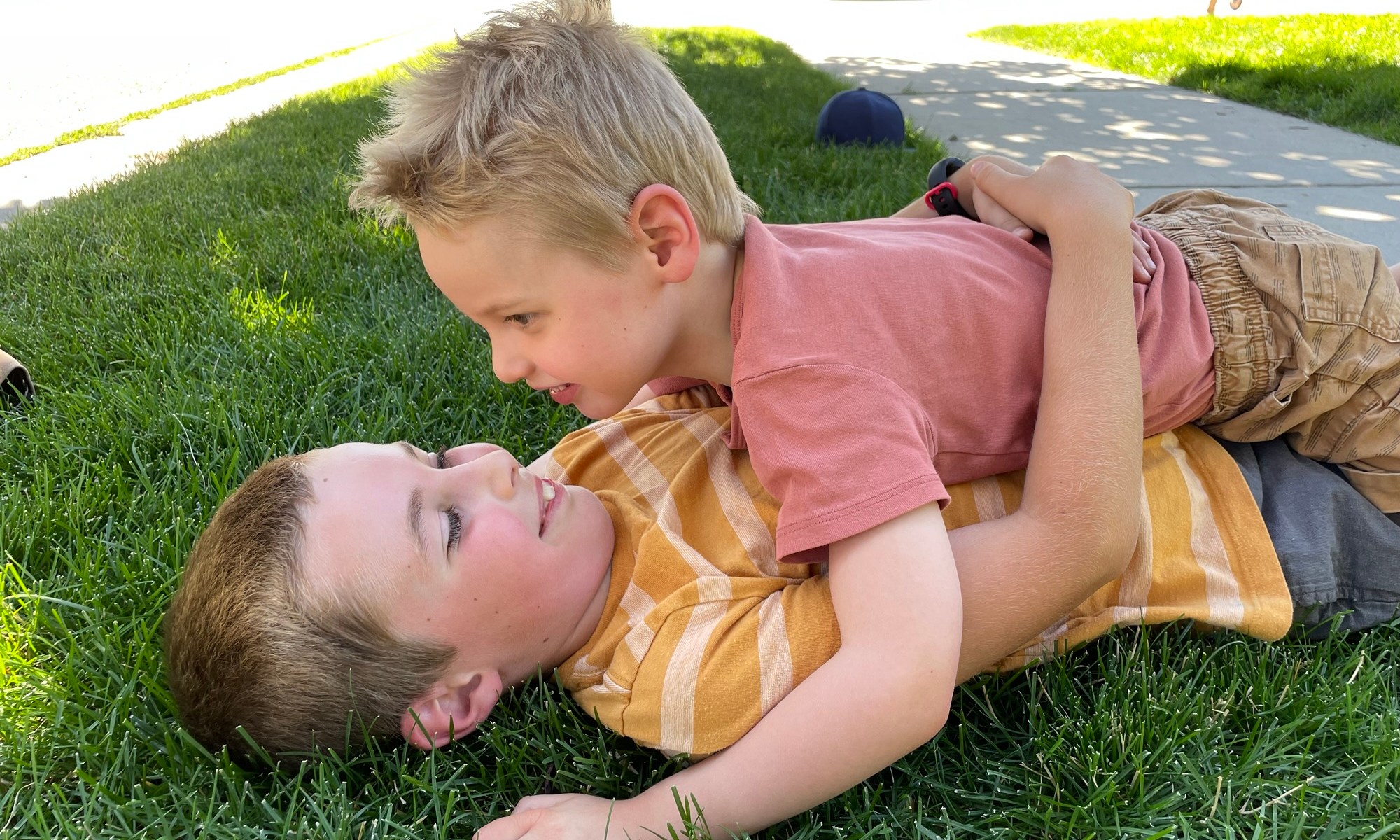
“Mom, I wish I had a brother to wrestle with. I love Shep, I just wish he could wrestle with me,” Harrison timidly confessed.
“I know, buddy. I understand,” I replied.
This was not the first time my 8 year old son shared this sentiment with me. I was simultaneously pierced by his words and proud of him for telling me how he really felt. I was struck by the irony that the very thing Harrison was pining after was exactly what he was doing—wrestling. He wasn’t wrestling with his brother. He was wrestling with God.

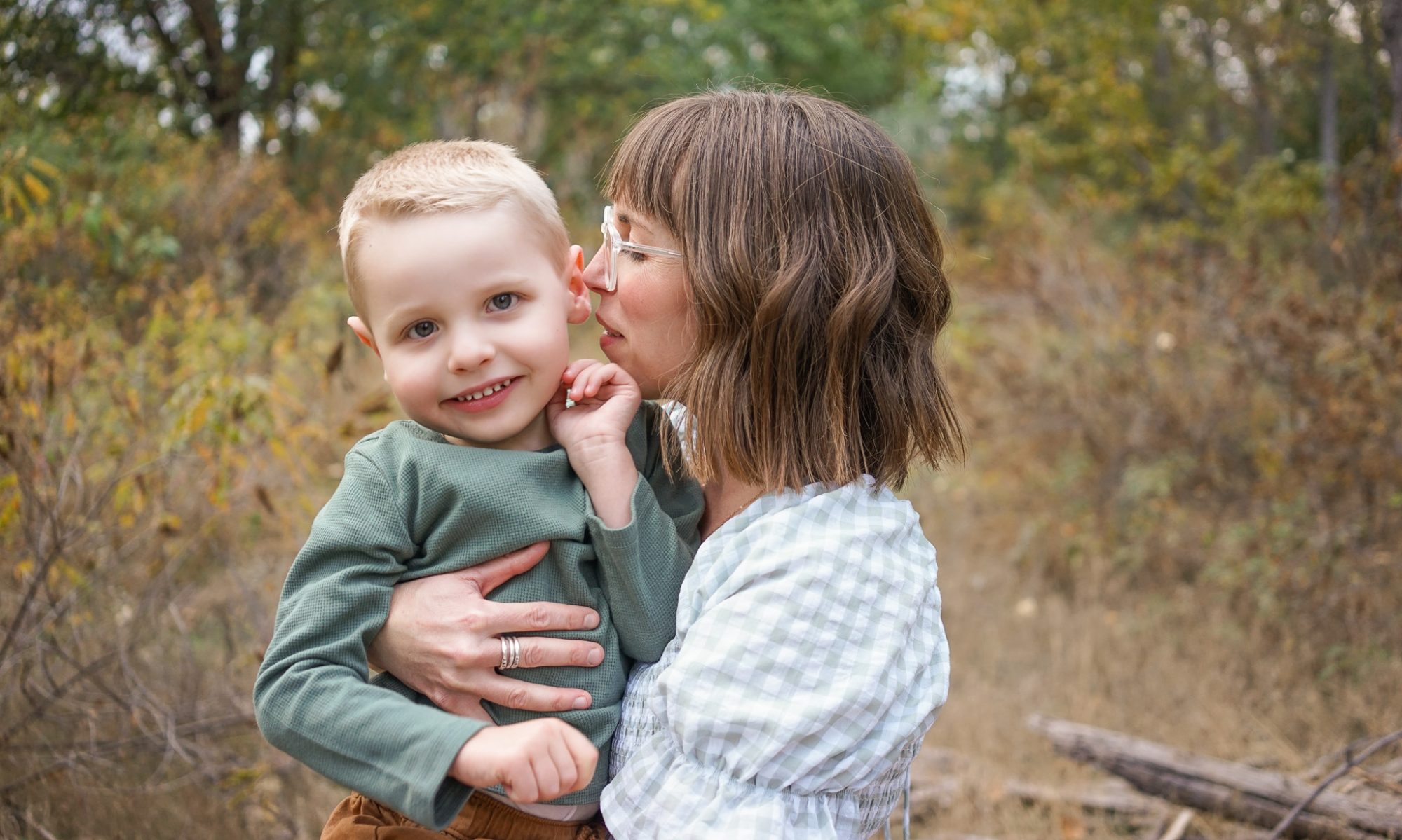
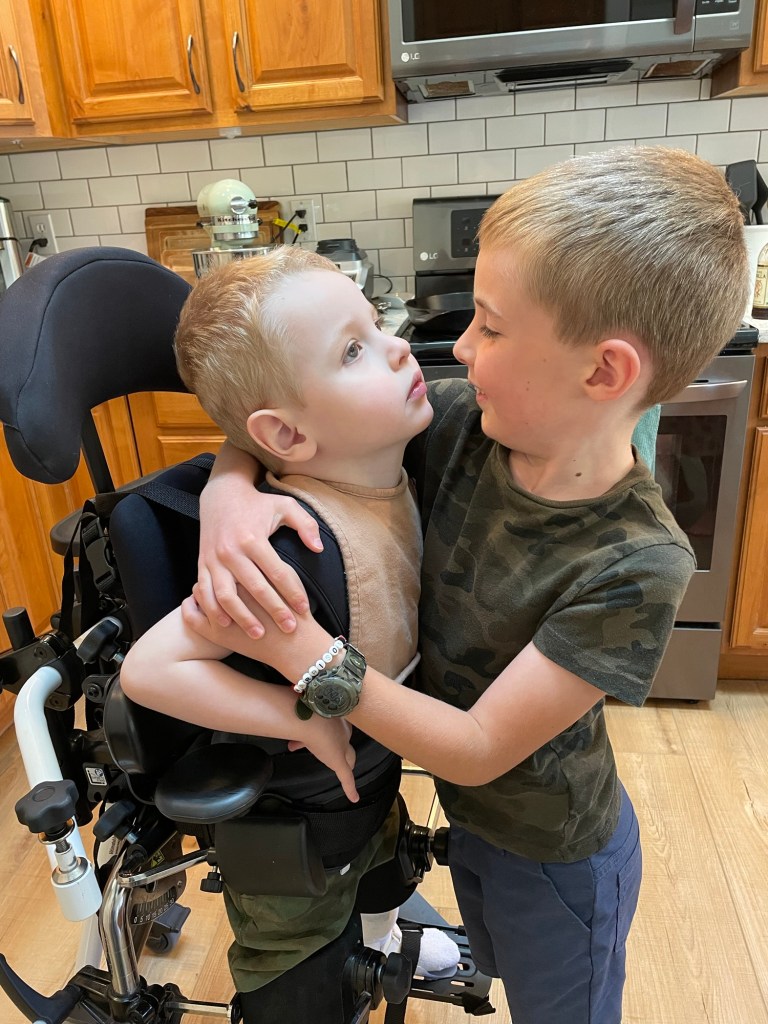
My husband and I have had numerous conversations about how having a disabled son is not only going to impact us, but our other children as well. Just as we have had to process a reality that is far from our expectations and grieve losses, we will need to give Harrison and Poppy the space to process and grieve in their own ways. I shared in a post several months ago that our daughter Poppy is somewhat of an anomaly, in that she appears largely unphased by the setbacks of disability and has not skipped a beat since Shep entered our lives (thus far).
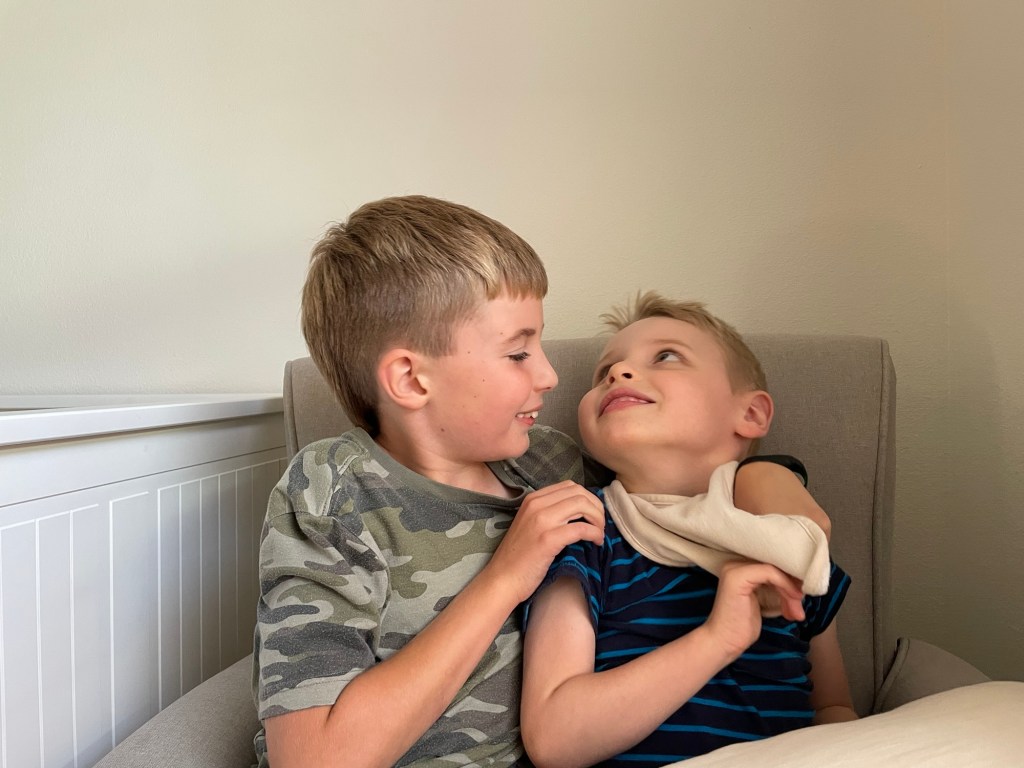
With Harrison, however, we’ve watched him work through his own struggles with having an atypical life due to the confines of disability. Harrison has had to surrender his expectations for what having a little brother would look like. Harrison won’t be teaching his brother to play catch or taking him for bike rides. They won’t love the same books or stay up late talking from a shared bunkbed. They won’t wrestle. Shep naturally slows down our pace of life, which is hard to swallow for my go-getter, extroverted, do-all-the-things son, Harrison. These are undeniable daily losses for him to grieve and he is learning to wrestle through these at a young age.
While it can be easy to look at Poppy’s ability to take life’s setbacks in stride with great admiration, I’m humbled when I think about how much my journey with Shep mirrors Harrison’s. I too, have wrestled with God and continue to do so.
At times, within the Christian community, there is the temptation to race through our trials and feign “okayness” to try to prove to the world that our faith in God is solid and we cannot be shaken. Yet, in reality, taking time to wrestle with God in the midst of our hurt can actually prove to sharpen our faith and draw us nearer to God.
The theme of wrestling appears repeatedly throughout scripture. Job was counted a righteous man and clung to God in the midst of losing every single thing he had— his family, his wealth, his health, his friends. We read his story and are inspired by Job’s initial response “‘Naked I came from my mother’s womb, and naked shall I return there. The Lord gave, and the Lord has taken away; blessed be the name of the Lord’” (Job 1:21). Yet, this same man goes on to say to God, “‘Show me why you contend with me. Does it seem good to You that You should oppress, that You should despise the work of Your hands’” (Job 10:2-3) and “‘Your hands have made me and fashioned me, an intricate unity; Yet you would destroy me’” (vs. 8).
Job is asking the question we’ve all asked at one point or another in the face of hardship— “Why, God?” He is hurting and is not quite ready to take his undesirable circumstances lying down. While Job recognizes God’s sovereignty, he is still wrestling with God over why He would allow such terrible afflictions into His life if God truly made and loved him. This pendulum we see with Job swaying between “blessed be the name of the Lord” and “why me, God?” is oh, so human. Job was not unshakable. He had questions and doubts, and he brought them straight to God himself. Yet, he was still counted a righteous man.
God meets Job where he is at, in the midst of his questioning, and in a somewhat frustrating turn of events, He does not answer all of Job’s questions. He, instead, reminds Job who He is. He is the all-knowing, all-powerful, omnipotent, sovereign God. Our understanding of the world and our own lives pales in comparison to His. This humbling encounter with God leads Job to repent of his pride, and confess that he “uttered what he did not understand” (Job 42:3).Their exchange ends with Job stating, “‘I have heard of You by the hearing of the ear, but now my eye sees You’” (Job 42:5). This back and forth wrestling match draws Job nearer to God and allows him to experience God more intimately than he ever had before.
Another well-known man to wrestle with God in this manner was David, who authored many of the psalms. There are countless examples of David taking his authentic expressions of grief, doubt, fear, and anger directly to God. He wrestles through his own “why God?” questions when he is struggling with feeling abandoned and forsaken. The beauty of these psalms is that David’s unfiltered emotions are spilled out before God right alongside his expression of faith and trust in God, creating a tension—a push and pull—much like wrestling. This is evidence that our relationship with God is never one dimensional. It has depth, just like our other human relationships do. If you’re curious to read some of David’s wrestling for yourself, check out Psalm 13, 22, and 44 for starters.
Finally, I would be remiss to not mention the strangest account of wrestling in the Bible. Jacob, a man who had been promised so much by God, still struggled with fear, insecurity, and doubt. The day before he was about to be reunited with the vengeful twin brother he’d cheated and stolen from, Jacob was afraid and cried out to God for deliverance (Genesis 32:11). Jacob spent a sleepless night alone in the wilderness until a “stranger” showed up. Jacob proceeded to physically wrestle with God all night. God touched Jacob’s hip socket, putting his hip out of joint, and Jacob stubbornly declared, “‘I will not let go unless you bless me!’” (Genesis 32:26).
This odd story that occurred very much in the physical realm is a picture of the spiritual reality at play. Jacob was after God’s deliverance, His blessing, His peace. Those things could only be attained by drawing near to God and wrestling with Him through his fears and doubts. This wrestling match with God led Jacob to declare, “‘I have seen God face to face’” (Genesis 32:30) — an intimacy you cannot claim until you’ve gone toe to toe with God. My favorite detail of this story is that Jacob was left with a limp—a tangible reminder of his encounter with God. This mark of weakness that Jacob would carry with him daily would serve as a reminder of God’s strength, his own frailty, and the time that God drew intimately near.
When I reflect on these three varied accounts, I see how God not only allows our wrestling, but invites us into it and uses it to refine our faith. It is normal to question “why?” when life does not go according to our plan. But so much hinges on where we go with our questions. God wants us to take our doubts, fears, questions and raw emotions to Him, not away from Him. We may not get all the answers we seek, but we just might get a closer glimpse of God Himself.
You have to be close to someone to wrestle with them, and God is constantly beckoning us to come closer. Throughout scripture, God extends invitations for us to draw near to Him in verses such as these: “Come to me, all you who are weary and heavy burdened, and I will give you rest” (Matthew 11:28) and “Cast your anxiety on him because he cares for you” (1 Peter 5:7). These are not empty words from a distant God. These are promises to meet our wrestling with a loving embrace. God promises to draw near to us as we draw near to Him (James 4:8).
I want to add that true wrestling entails bringing your questions to God with the intent of actually seeking to find God in the midst of your mess. The New Testament is full of Pharisees who questioned Jesus with the motive of trapping and disproving Him. Their questions were not sincere—they had already made their minds up about who Jesus was. This kind of questioning is not going to refine your faith. But questions asked from a heart that is sincerely trying to find God in the valley, will do so.
This is my prayer for my Harrison, and for myself—that we would have the courage to wrestle with God in our darkest moments and in doing so, we would see Him face to face. I pray we would not be left unchanged in our wrestling, but be granted the gift of a limp as a daily reminder of a loving God who draws near.
And what about you, friend? With the heaviness in your own heart– are you wrestling with God or running from Him?

 Good Shepherd